Every territory.
Every standard.
One digital solution.
Analog radio bled across borders. An Estonian on the coast could catch Finnish TV even though no standard sanctioned it. Digital systems are not forgiving. They draw knife-sharp lines from country codes that flatten the distinctions that matter: Åland is an autonomous region of Finland but sits outside the EU VAT area; the Canaries are Spanish but use IGIC instead of VAT; Northern Ireland sits inside both the UK and the EU customs regimes at once. TLL captures every such exception in one place, so minorities and special regions get the same first-class digital service as everyone else. Starting with the EU.
A country code is not a rule set.
Dozens of territories around the world sit partly inside and partly outside the regimes that commerce stacks model as single countries: customs unions, VAT areas, licensing zones, postal networks. ISO 3166-1, ISO 3166-2, WIPO ST.3, EU VAT, and UPU each answer differently. The stack silently picks one, and gets the rest wrong. We start with the EU special regions because that is where European commerce platforms feel the pain first.
Checkout breaks.
Country selector doesn't know the territory exists, or aliases it to its sovereign parent. Valid addresses bounce with a generic error.
abandoned cartsTax is wrong.
Parent country's VAT rate is applied. The territory may be outside the VAT area, under a local regime, or require a customs declaration instead.
tax exposure · per-orderDelivery fails.
Carrier routes as domestic. Parcel arrives at an international sorting facility without paperwork, is held or returned to sender.
SLA missNine layers. One territorial truth.
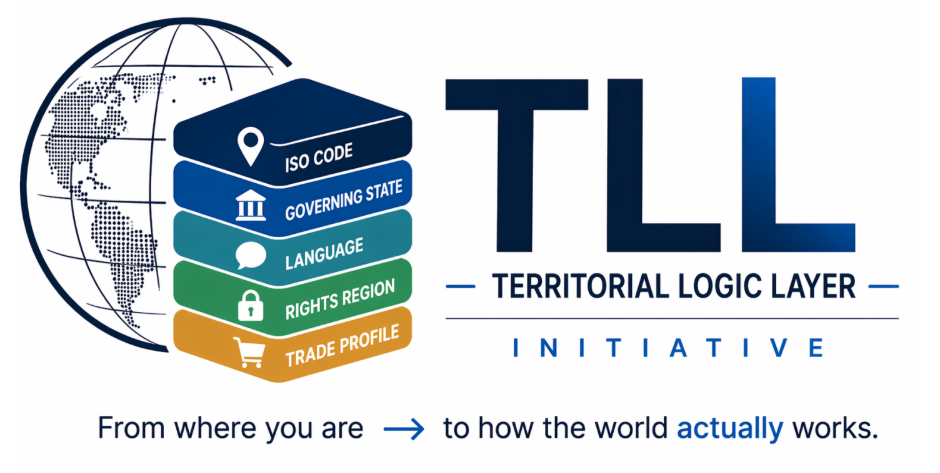
Every territory resolves to a structured profile across nine independent dimensions. Each field is versioned, source-cited, and carries a confidence flag. No more guessing which spreadsheet is canonical.
ISO Code
Resolves 3166-1, 3166-2, and WIPO ST.3 conflicts. Returns a single canonical identifier and an alias set.
Governing State
Sovereign parent, effective administrator, and degree of autonomy. Finland for Åland, Denmark for Faroe, Spain for Canaries.
Language
Official, administrative, and default content language with fallback chain. Swedish for Åland, not Finnish.
Rights Region
Where this territory belongs for media licensing, streaming windows, and geo-IP targeting.
Content Profile
Regional catalog rules, ratings regime, and permitted content categories. Maps to your CMS region taxonomy.
Tax & Customs
VAT regime, rate table, customs union membership, and paperwork requirement. The field most get wrong.
Trade Profile
Bilateral agreements, sanctions posture, and export control classification inherited or overridden.
Logistics Routing
Domestic vs international routing hint, carrier compatibility matrix, and recommended service levels.
Postal Code
Valid postcode ranges, UPU prefix rules, and address format template for printed labels.
Ask the right question,
get the right answer.
TLL doesn't make you reason about standards. You ask a decision question, TLL returns a decision. Request schemas are stable; responses carry source citations and a confidence score.
{ "country": "FI", "postcode": "22100" }
→ { "iso": "AX", "confidence": 0.99 } { "iso": "AX", "basket_eur": 4900 }
→ { "rate": 0, "regime": "outside_eu_vat" } { "from": "SE", "to": "AX" }
→ { "route": "intl", "customs": true } { "address": {...}, "basket": [...] }
→ { "territory": {...}, "vat": {...}, "logistics": {...} } Global scope. EU special regions first.
Every ISO 3166-1 country plus every known special territory: dependencies, autonomous regions, outermost regions, OCTs, customs exceptions. The initial seed prioritizes the EU hybrid and external profiles where commerce stacks break most often, starting with Åland, the Canary Islands, Northern Ireland, and the DROM. Global coverage rolls out from there.
| Code | Territory | Sovereign parent | VAT regime | Status |
|---|---|---|---|---|
| AX | Åland Islands FI-01 · in EU customs · outside EU VAT | Finland | 0% · outside EU VAT | hybrid |
| IC | Canary Islands ES-CN · in EU customs · IGIC not VAT | Spain | IGIC 7% · outside EU VAT | hybrid |
| XI | Northern Ireland GB-NIR · Windsor framework | United Kingdom | UK VAT · EU goods rules | hybrid |
| RE | Réunion FR-RE · OMR · special VAT | France | 8.5% · special rate | hybrid |
| FO | Faroe Islands DK-FO · outside EU | Denmark | MVG 25% · non-EU | external |
| GL | Greenland DK-GL · OCT · outside EU | Denmark | no VAT · import duty | external |
| GI | Gibraltar GB-GI · outside UK VAT | United Kingdom | no VAT | external |
| PM | Saint-Pierre & Miquelon FR-PM · OCT | France | no VAT · local tax | external |
| IM | Isle of Man GB-IOM · UK customs union | United Kingdom | UK VAT · shared | consistent |
Every country.
Every territory.
Every checkout.
Start in test mode in under a minute. Initial live coverage focuses on EU special regions, broader rollout ongoing. Contact sales for live data, SLAs, and regional residency.